
Macro/Oil/Investing - Into The Void?
We are walking a tightrope between wildly divergent Macro outcomes, where one path leads to the Goldilocks of Disinflationary Growth, and another path leads into the void of Stagflation/Reflation.
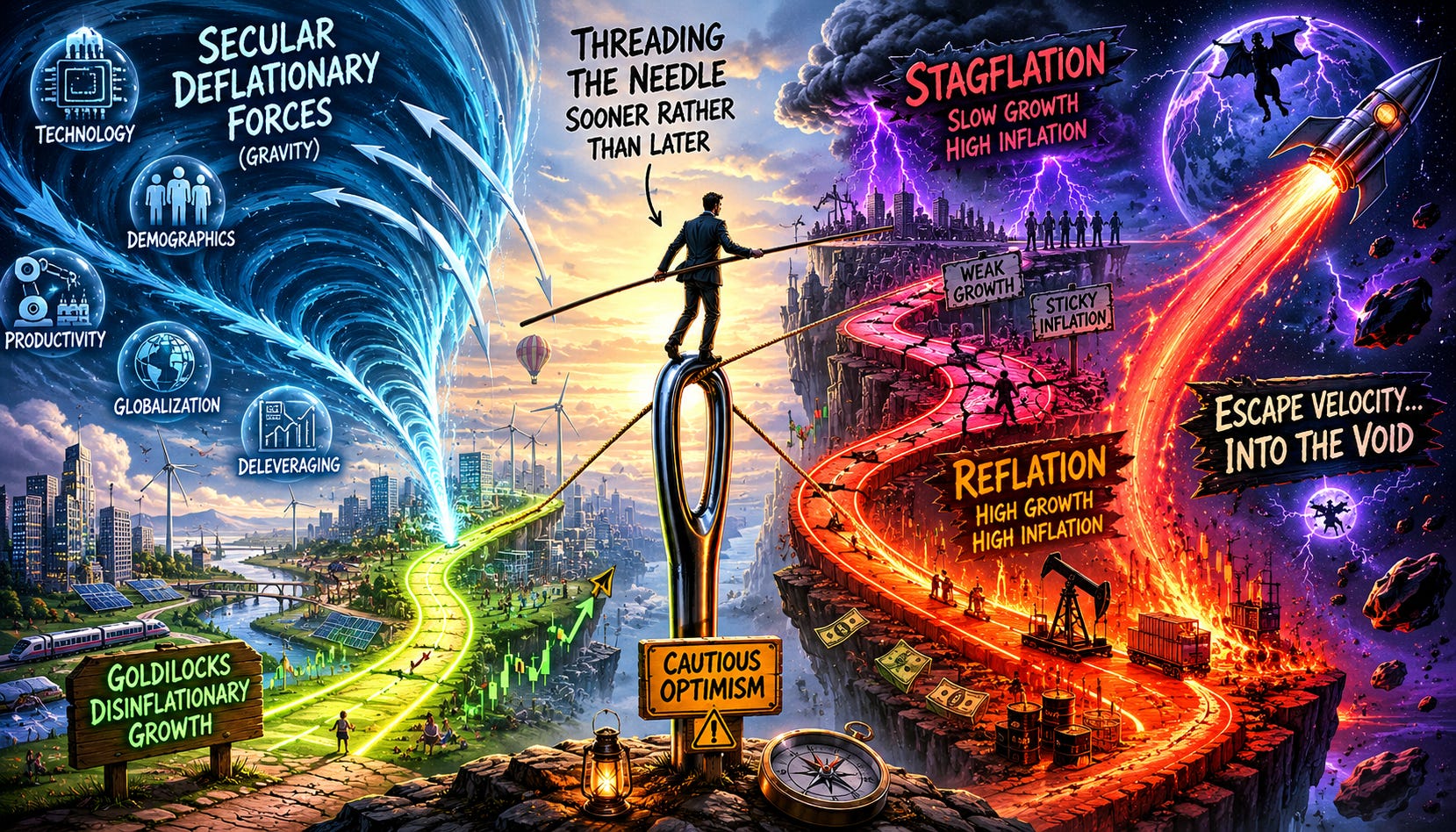
I was part of a roundtable at the LA branch of the SF Federal Reserve Bank last week, where I summarized some of these views. Each branch of the Fed conducts these roundtables regularly with local business leaders to get a qualitative pulse on the economy. I gave my view that we are at a Macroeconomic Crossroads — one largely driven by the Geopolitical conflict in the Middle East.
The Macro Backdrop Before the Iran War
Throughout last year, I gave my contrarian views that the Trump 2.0 Playbook was net Deflationary and that those forces could counter a pre-existing Inflationary backdrop, resulting in Disinflationary Productivity-led Growth.
My Base Case was that the Tariff War would not be Inflationary because of its Demand Destruction / Redirection effects as well as the bundled Re-shoring initiatives (so large that I dubbed it the Reverse Marshall Plan). The addition of Low Oil Prices from a friendly Saudi Arabia and UAE (who were sitting on huge amounts of Spare Capacity) plus AI-led Productivity Growth would lead to the Holy Grail of Disinflationary Growth, similar to the Goldilocks period that we experienced in the mid-1990s that led to Budget Surpluses.
The Macro Regime function on UrbanKaoberg.com, which shows a scatterplot of Inflation Momentum against Growth Momentum, showed that we were indeed in the Goldilocks regime as of March, 2025.
I summarized all of these points last fall:
As predicted, Tariffs not only did not stoke Inflation, they exerted Deflationary effects from Demand Destruction. Macro Regime was showing as recently as last December that we were on a knife’s edge between the Goldilocks and Deflationary Regimes.
But the Re-shoring boom and the Reverse Marshall Plan were just getting started to jumpstart flagging growth.
Not only was Inflation cooling…
…but there were many signs over the next several months that economic growth was starting to re-accelerate.
If you looked at what GDP, ISM Manufacturing and Industrial Production did over the last several months, you would have concluded rightly that the Goldilocks scenario we saw in March, 2025 was once again within reach:
The Iran War
On February 28, 2026, US and Israeli forces initiated strikes on dozens of military and security bases across Iran. The initial operations resulted in the deaths of top Iranian leadership, including Supreme Leader Ali Khamenei.
Thus began the Iran War — and everything changed.
The most important Oil chokepoint in the world, the Strait of Hormuz, has effectively been shut for over 80 days, and the resultant disruptions in Oil and Product flows have taken us way off track from Goldilocks.
Here is the Yield Curve, before the Iran War (in blue) and now (in yellow):
Here is the WTI Oil Forward Curve, before the Iran War (in blue) and now (in red):
Macro Regime now shows that we are straddling Stagflation and Reflation Regimes.
I do not think Reflation is in the cards, but I do think Stagflation is a real risk.
The reason is because this bout of Oil Inflation is not Demand-led like the post-COVID Oil Bull of 2021.
This is a pure Supply Shock that is Demand Destructive, dampening both Aggregate Demand and economic growth, and I believe the Fed is stuck between the Scylla of hiking (and further crushing the consumer) and Charybdis of easing (and goosing up even more Inflation).
Oil: The Linchpin of the Macroeconomy
Memorial Day Weekend is known as the traditional kickoff to the summer driving season for Oil / Gasoline — and this year, we seem to be teetering between bimodal outcomes for Oil, which in turn could mean bimodal outcomes for the economy and markets as well.
If there’s anything that’s going to derail the Trump 2.0 Deflationary Playbook, it will be prolonged elevated Oil prices.
I’ve written at length about the importance of Oil to the Macroeconomy since 2021. Given its importance as a feedstock to almost all corners of the economy, from Transportation to Manufacturing to Petrochemicals, Oil is a critical driver of Inflation.
For reference, here is a directory to all of my past writings on Oil and its effect on the Macroeconomy and USD:
Ironically, huge Spare Capacity and low Oil prices were one of the key reasons why I thought the Trump 2.0 Playbook was net Deflationary despite the Tariff War. The Iran War changed everything by shutting down the Strait of Hormuz and rendering all the Spare Capacity useless. This was not on my Bingo card, and I don’t think the Administration expected Iran to have this much leverage over the Strait, either.
My friend Lakshmi Sreekumar, Macro analyst at Capital One, came out today with a detailed note summarizing a call I attended earlier in the week about the negotiations around Iran’s 14-point plan.
Here’s a bullet summary of the terms along with Lakshmi’s assessment of the Administration’s stance:
Full cessation of war within 30 days - Negotiable if broader deal works
Regional conflict resolution, including Lebanon ceasefire - U.S. likely agrees
Lift naval blockade on Iranian ports - U.S. likely agrees
New Strait of Hormuz coordination mechanism recognizing Iranian regulatory authority - U.S. unclear (I highly doubt it); UAE/KSA likely oppose
Remove all U.S. sanctions and reverse recent UN actions - U.S. likely agrees
Release frozen Iranian assets - U.S. likely agrees
War reparations from U.S. for infrastructure damage - U.S. does not agree
Withdrawal of U.S. forces/assets near Iran - U.S. does not agree
Sovereignty guarantees against future preemptive strikes/regime-change policy - U.S. likely agrees, but may view as diplomatically flexible / weakly enforceable
Right to enrichment / peaceful nuclear activity under NPT, with Iran offering initial non-enrichment period and sunset structure - Core make-or-break issue. Lakshmi thinks Iran’s offer is stronger than JCPOA for the U.S., but U.S. wants tougher/longer terms, especially on nuclear dust / highly enriched particles
Separate one-month nuclear negotiation window after war ends - U.S. position unclear; Vance reportedly wants nuclear file concluded as part of the deal
Oil sanctions waiver during negotiations - U.S. likely agrees if Iran concedes on nuclear file
Monitoring/verification of U.S. sanctions removal compliance - U.S. likely agrees
Prisoner exchange - Gray area; U.S. position unclear because Israel holds many prisoners
Scenario 1: Peace Deal
Although there are some terms that could be dealbreakers for the US (mainly around nuclear enrichment), she thinks there is a path to a settlement because it is still a substantially better deal for the US than the original JCPOA and therefore sellable to the U.S. electorate as a “win.”
That said, most Oil experts including Lakshmi agree that even if we have an imminent deal, the path to normalization of flows will be at least 60+ days. But more importantly, she highlights the 3.6 mmbpd of damaged ME refining capacity which could take 6 MONTHS to come back.
All in, she estimates that GLOBAL refining runs are down 7 mmbpd, translating into almost 6.5 mmbpd of Product Demand Destruction. In this scenario, we could see Oil drop into the $70’s even as Products stay highly elevated.
Unfortunately, it’s Products that comprise consumer-facing Inflation.
Given Oil’s prominent position as a feedstock to all parts of the economy, one cannot underestimate the impact of this disruption despite significant secular Deflationary effects of AI-led Productivity Growth.
It’s going to accelerate PERMANENT Substitution Demand Destruction for Oil-based Transport fuels. Although I just bought my first Tesla for FSD (Full Self-Driving) features, the side benefit of not having to pay $7+ gasoline in CA is nice.
If Oil goes to $150, you can be sure there will be EV switching en masse — and not necessarily due to FSD. That will result in quasi-permanent Demand Destruction due to Substitution, and will only accelerate the thesis I espoused a couple months ago that Gas (Natural Gas) will become more important than Oil over time:
Scenario 2: Escalation
This is really not a scenario anyone wants to contemplate, and the market is certainly whistling past the graveyard on a non-negligible risk.
This interview with Morgan Downey is a must-listen.
Morgan agrees with Lakshmi that even the Peace Deal Scenario would see continued disruptions in flows for many months, but he was far more alarmist in terms of upside targets for Oil. He thinks Oil will need to reprice significantly higher in order to solve for approximately 10 mmbpd of Demand Destruction.
Morgan spells out the scary Escalation scenario that sees $150-$200 Oil, noting that $150 Oil presaged the GFC and that most people tend to focus only on the Housing Bubble, and not enough focus on the fact that high Oil was likely the catalyst that popped the bubble.
Conclusion
I agree with both Lakshmi and Morgan that the disruptions are real and that the Escalation Scenario presents grave dangers to the global economy. I think the Administration knows this and is seeking a viable off-ramp that will prevent a nuclear Iran.
The wildcard to me is the leadership of Iran, which reminds me of the mythical Hydra — where one head is decapitated, two new ones sprout in its place. It’s not clear to me that we can even be sure who we’re negotiating with and whether or not they represent lasting authority.
Even though my Base Case is that some detente is reached, the probability tails of potential outcomes are really fat here, and between the AI-led euphoric Teflon market and an upcoming slate of unprecedented new share issuance at unprecedented valuations, I am decidedly nervous and have been taking defensive steps.
If they are successful in threading the needle sooner than later, I am still cautiously optimistic that the secular Deflationary forces set in motion prior to the Iran War will act like gravity and draw us back to a Goldilocks Disinflationary Growth path.
However, there are worrisome signs as this stalemate drags on, as Friday’s UMich Consumer Sentiment and Inflation Expectations numbers indicate:
My concern is that if they do not resolve this soon, we could drift farther and farther away into the Stagflation Scenario, which would crush Consumer Sentiment, or the Reflation Scenario, which would untether Inflation Expectations. If this keeps up, we will achieve escape velocity from that benign gravity and hurtle “Into the Void” — had to throw in a Black Sabbath/Metal reference!


