


Welcome to the Weekly KAOS — UrbanKaoboy’s end-of-week roundup covering Macro and Geopolitics, where I try and tease out the most impactful bits of the week.
Themes of the Week
The Treasury backstops the long bond as the debt clock crosses $40T, but I argue that the USD’s crown is contested at the Geopolitical chokepoints, not in the ledger; the Debt Governor bites the AI trade
The Global Reserve Currency (GRC) crown is a funny thing. When you’re king of the hill, everyone wants to see you get taken down. This has been going on for decades, and this week the Macro commentariat spent its energy taking the US Treasury’s temperature: a debt clock ticking past $40T, a July Deficit of $432B, net interest now crowding out national defense, and Scott Bessent quietly doubling the size of his long-bond buybacks to keep the 30-year from running away. Read as a headline, it is the Debasement story the End-of-American-Exceptionalism crowd loves to tell every couple of years (months?).
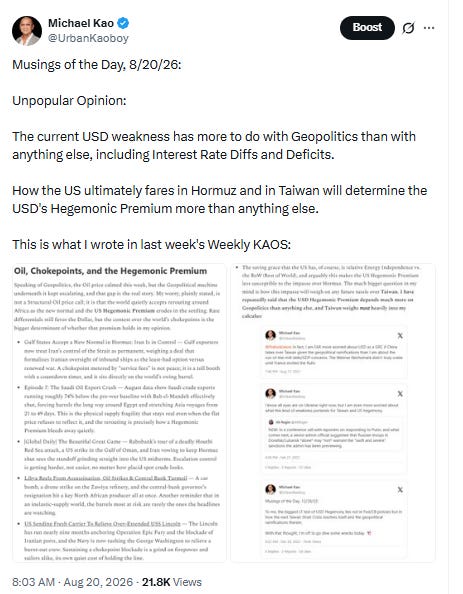
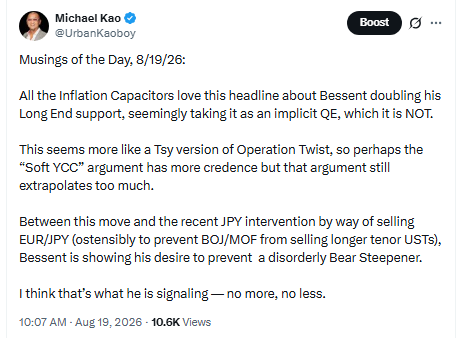
I read it differently. As I posted this week, the Dollar’s Hegemonic Premium has far more to do with Geopolitics than with Rate Differentials or the Deficit, and the buyback is not the QE the Inflation Capacitors want it to be, it is closer to a Treasury-run Operation Twist, a Soft YCC at most. A crown is not lost at the auction desk. It is lost at the borders, in the straits, and over the chokepoints, and that is where I am watching.
On the surface, Oil caught a fresh war bid on Trump’s “economic D-Day” threat, but the reality is that Hormuz has become a leaky Sieve — in a good way for consumers and for King Dollar.
Meanwhile, the AI buildout kept borrowing its way into the bond market, and the data stayed stubbornly benign. Underneath, the Pentagon is weighing a smaller Gulf footprint, China keeps pressing our Asian allies while Washington stares at Iran, and the world quietly learns to reroute around the very chokepoints that underwrite American power.
The Deficit is the first order analysis that pundits breathlessly use to sell fear-mongering newsletters (for decades!), but to me, analysis of Geopolitics and National Power is the second order and much more important analysis that really matters.
This Weekly KAOS is FREE. If you like what you see, please consider upgrading to Paid, where you will get the full Archive, the Daily Chats, and free access to UrbanKaoberg’s Closed Beta!
The Dollar’s Crown Isn’t Decided in the Deficit
The week’s fiscal fireworks read as a Debasement story, but I think the Dollar’s crown rests primarily on National Power and Geography, a case I made in detail at West Point three years ago.
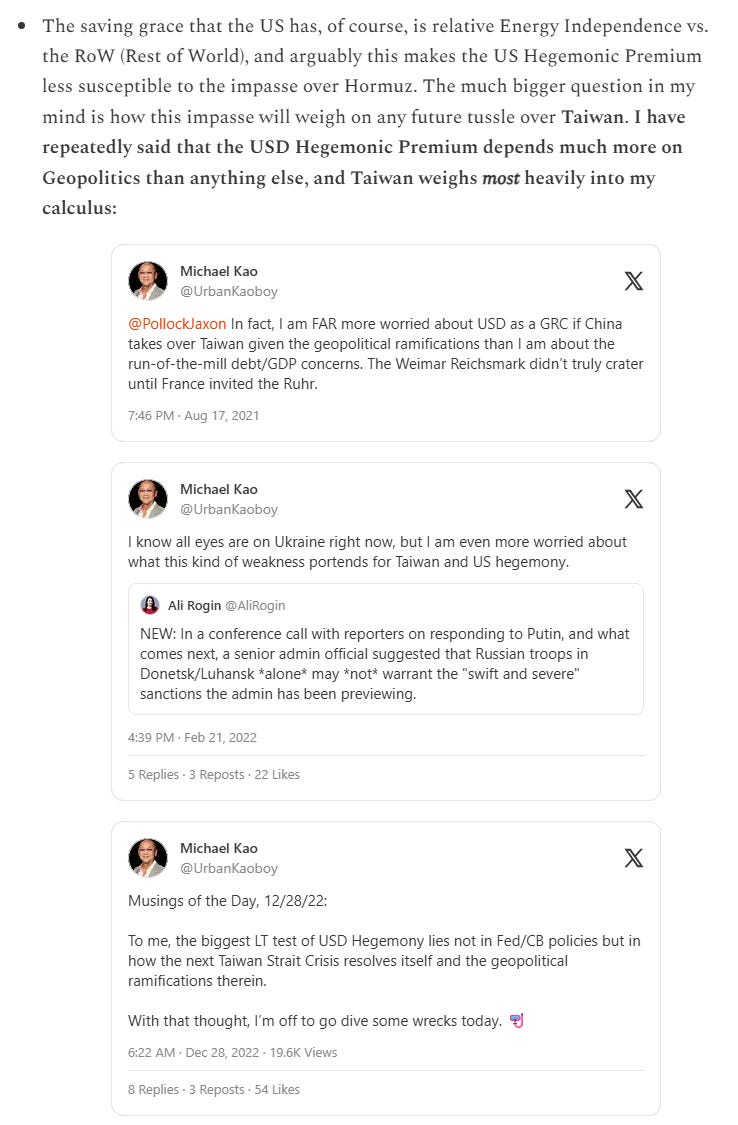
I believe the recent USD weakness to be the market’s perception of an erosion of the Hegemonic Premium over the inability for the US to keep Hormuz fully open (yet). While Deficits always grip the headlines, I believe the real things to watch are the Geopolitical chokepoints. I wouldn’t count out the USD Hegemonic Premium just yet.
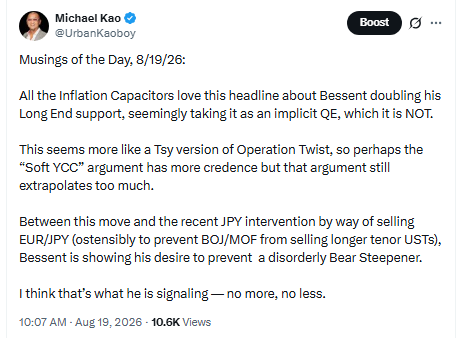
Sometimes, You Get What You Need — Michael Green reads the Treasury’s larger long-bond buybacks as the “aircraft carrier beginning to turn,” and the desk splits predictably: Robin Brooks calls it Dollar Debasement begun, Andrew Sarna sees an implicit yield cap with interest-to-GDP at a record, and Peter Boockvar dismisses it as temporary FX-style intervention. My read sits closer to Boockvar on the mechanics: this is Operation Twist in a Treasury wrapper, not the money-printing the Inflation Capacitors are pricing.
GREED & fear: 40 Trillion and Counting — Christopher Wood notes US public debt topped $40T with July’s Deficit at a record $432B and net interest plus entitlements now near 98.4% of receipts. Real numbers, and I do not wave them away, but the Vodka Red Bull Economy has been running hot for years without the bond vigilantes dethroning the Treasury, and I would not bet on this being the week they finally do.
Where Is the Global Debt Crisis Most Acute? — Brooks argues yield-capping central banks have muffled the usual distress signals, but the stress is building outside the US, not inside it. That is the cleanest dirty shirt in one chart: everyone hunts for the American debt crisis while Japan’s much higher Debt/GDP and Europe’s deteriorating Fiscal situation are the ones actually smoldering.
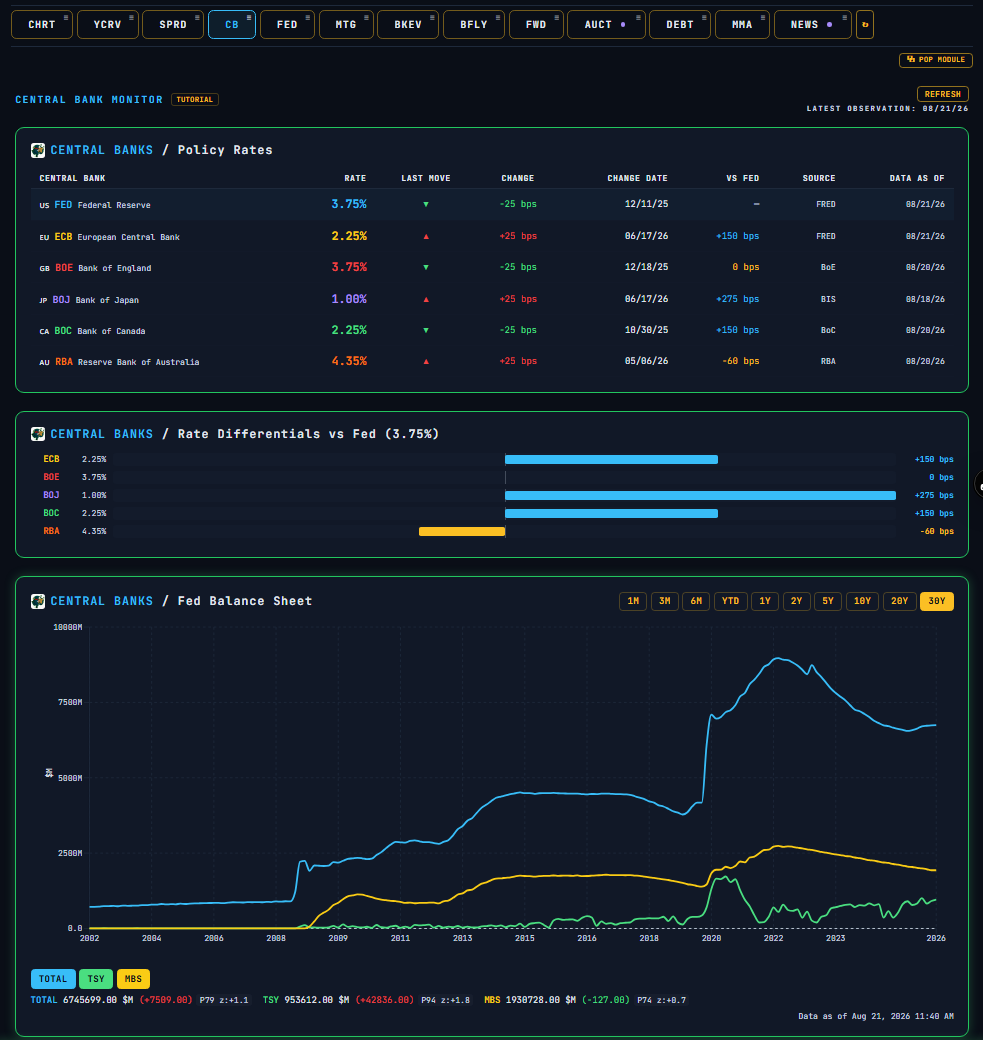
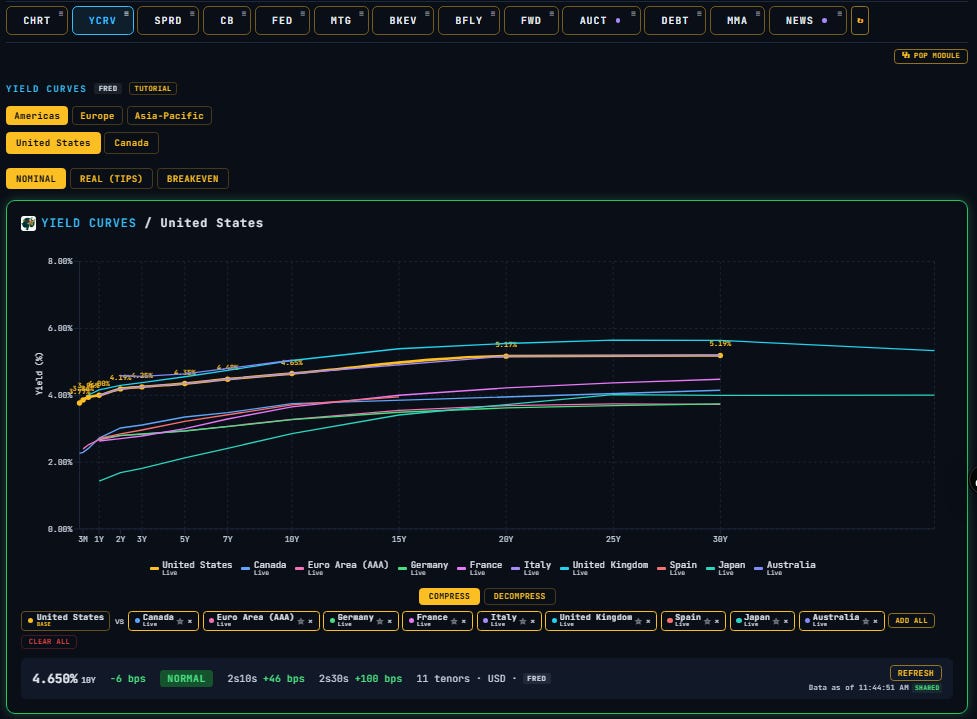
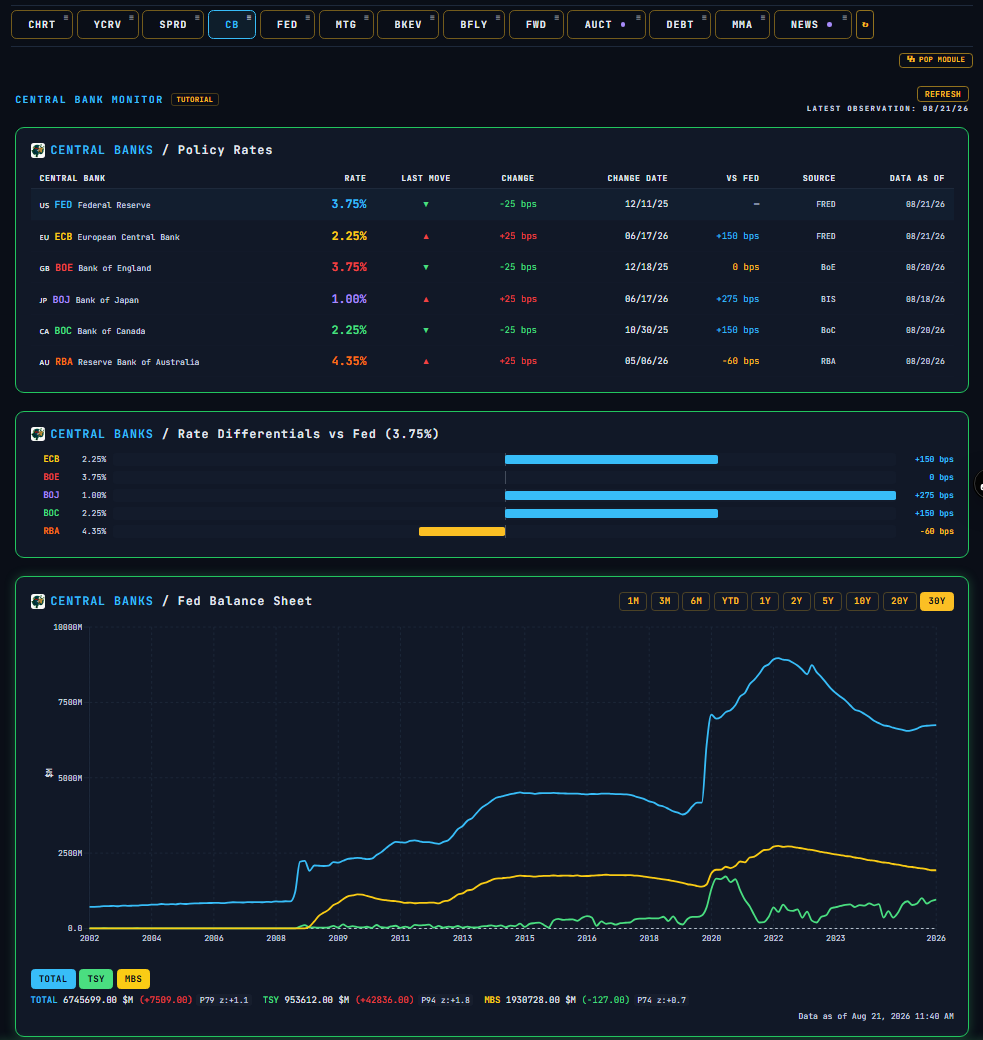
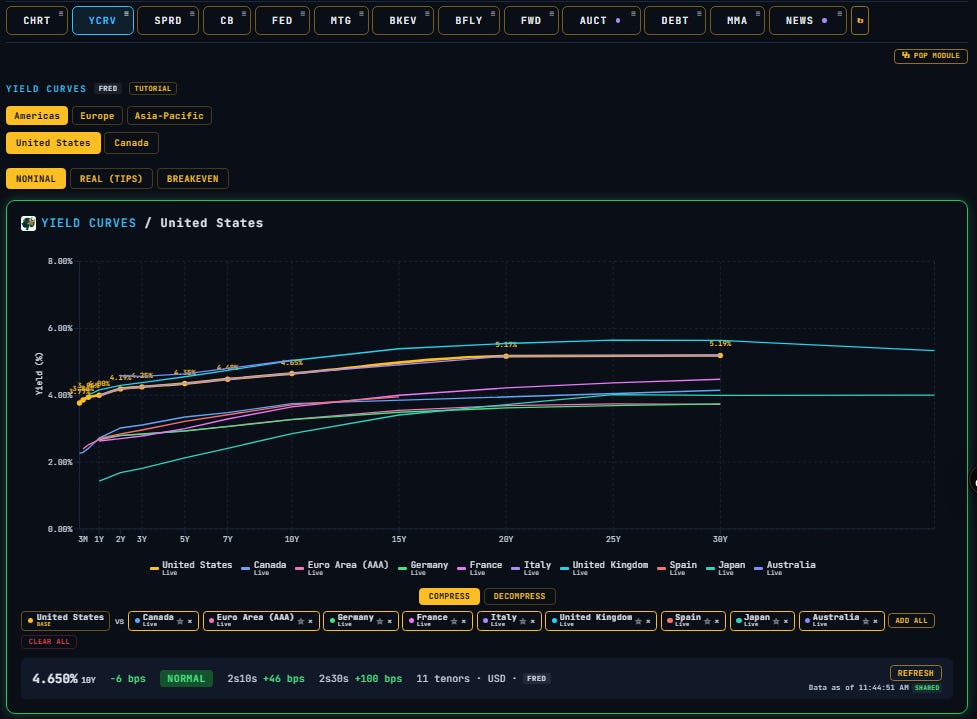
As for Rate Differentials and Yield Curves, take a look for yourself on UrbanKaoberg’s Rates Module. The US is not the outlier the Debasement crowd would have you believe:
Pentagon Weighing Smaller US Military Presence in Gulf Once Iran War Ends — This is a legitimate concern, but much more so for RoW than for the US. If Washington pulls back from strike-battered Gulf bases and the world settles into rerouting crude around Africa toward Asia, the US Hegemonic Premium could thin (I would argue that much of it is already priced in), because that premium used to be a function of who guards the world’s Oil plumbing. Again, US Geographical Advantages and Natural Resources mitigate this (unlike for RoW), as I mentioned last week:
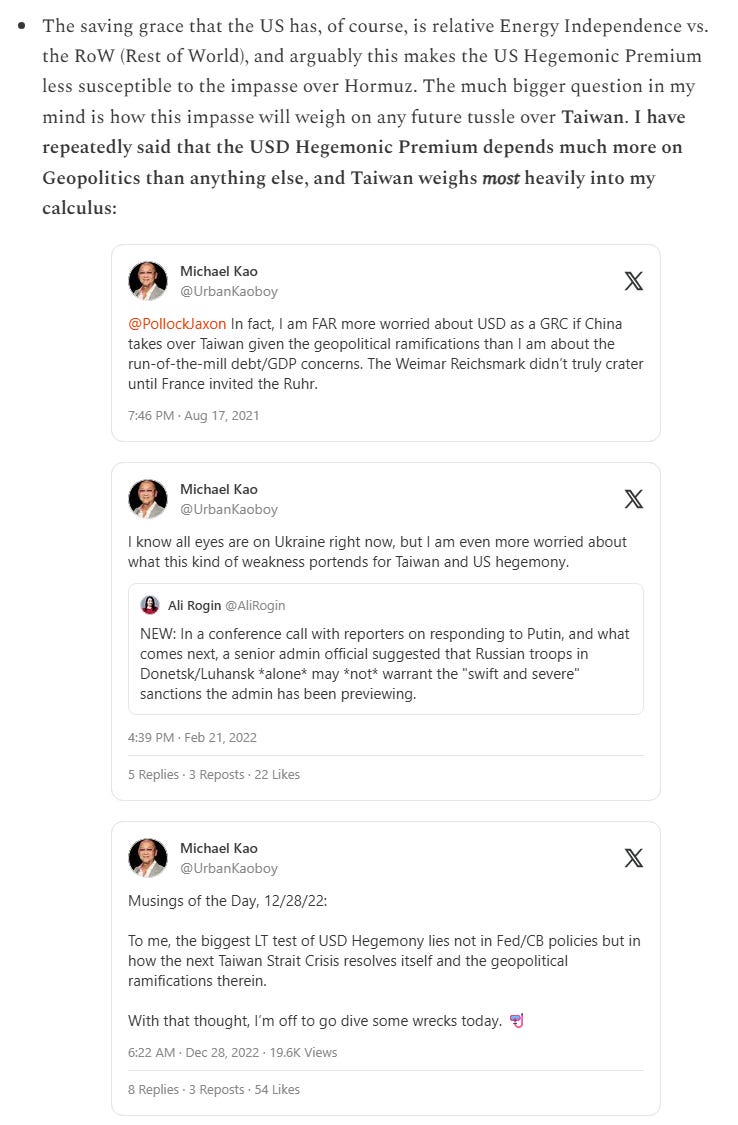
As China Pushes to Expand in Asia, Trump Focuses on Iran — Beijing intensifies coercion against the Philippines while our attention and munitions drain into the Gulf, and Asian allies quietly recalculate. Hormuz and Taiwan, not the auction calendar, are where the crown is defended.
Oil, Iran, and the Sieve
Oil caught a war bid again this week, and the war has settled into pure Economic Statecraft, exactly the frame Michael Every walked through on KAOS THEORY 13. Even Trump has adopted the term “Economic Warfare,” which was in the title of our West Point Paper: “US Dollar Primacy in an Age of Economic Warfare.”
The Message Behind Trump’s Threats of ‘Economic Warfare’ Against Iran — The “Economic D-Day” language reads as a bid for leverage rather than a wider shooting war, and that is the coherent play. Lakshmi’s view is that targeted Sanctions, not escalation, are the longer road (call it four to eight months) to any durable remodeling of the regime, and the only road that actually gets there.
Oil Prices Jump After Trump’s Latest Iran Threat — Crude spiked and bonds stayed jumpy after the latest threat, a reminder of how live the chokepoint premium remains even six months into a stalemate.
US Conducting Stealth Operation to Transport Oil Through Hormuz — Two US officials describe a nightly tanker corridor along Oman’s coast moving roughly half of pre-war volume back into the market. That is the mechanical answer to why crude bit but did not detonate, and it is one more toll booth with a countdown timer rather than anything resembling peace.
Oil Commentary: A Game of Cat and Mouse, Part II — Lakshmi Sreekumar (watch for her in the upcoming KAOS THEORY 14 at the end of this month) reiterates that Hormuz is a “true sieve,” with verifiable tanker data showing large volumes escaping the chokehold via the UAE-Sinokor shuttle running since April.
My view is that the more the market normalizes rerouting around Hormuz, the more the Hegemonic Premium on the USD leaks; the corollary is that if the Admin’s no-holds-barred Economic Warfare (Sanctions + Blockades + Naval Escorts) results in turning the Hormuz Sieve back into the Hormuz Spigot, the USD’s Hegemonic Premium will reassert itself.
The AI Buildout: The Debt Governor Meets the Power Wall
The AI trade stopped applauding capex for its own sake and started asking who funds the CASH INTEREST, which is my Debt Governor making itself felt. Between the Debt Governor, power bottlenecks and political pushback on data centers, I wonder whether AI’s growth will be stymied and therefore delay what I think will ultimately be a profoundly Deflationary impact on society.
This week Merck and Moderna’s personalized mRNA cancer vaccine hit its melanoma trial goals, and the tell is the shift from hunting for molecules to training AI to read the tumor itself, with the value migrating from the molecule to target selection. That is the Benign Gravity of Disinflationary Growth I keep hoping reasserts, not the side-door capex Inflation everyone frets over.
How Big Tech’s A.I. Borrowing Binge Is Driving Up Bond Yields — Analysts pin the climb in Treasury yields on debt-funded AI capex bleeding into the long end. Bubbles can inflate forever on Equity funny-money, but the moment the buildout goes DEBT-financed, ROI starts to matter again.
Nvidia’s Risky Business — Ben Thompson reaches for the Jay Cooke and Northern Pacific railroad panic to frame the vendor- and debt-financed buildout as systemic fragility. Vendor-financed demand is precisely what the Debt Governor eventually meters.
How Big Is Big? — Peter Boockvar argues GenAI’s benefits accrue to users, not builders, with maintenance capex and Chinese price wars eroding returns. I part ways with Boockvar on some issues (I am not in the Tariffs-crush-the-consumer camp), but he is asking the right question here.
I too have wondered about where AI value will ultimately accrue:
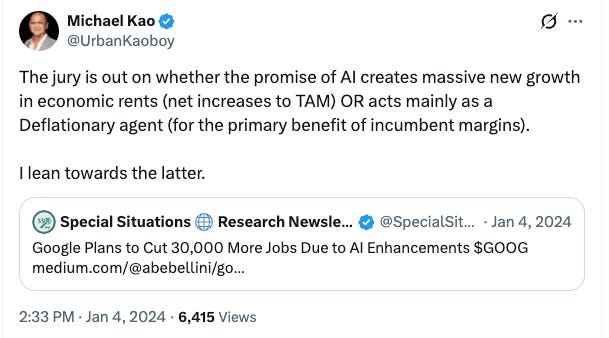
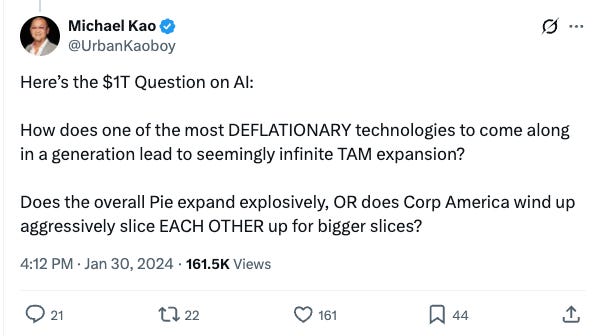

Barclays Convertibles Morning Commentary — Here is the biggest challenge to the debt-funded-vapor thesis: Anthropic’s preliminary Q2 revenue jumped roughly fourteen-fold year-over-year to more than $11.5B, with positive adjusted operating income. That is real monetization, not a mirage, and I will hold that fact next to the bubble worry rather than pretend it away.
PA Governor Is Serious: Bring New Generation for Data Centers — Governor Shapiro’s order forces new data centers to bring their own firm power or lose permitting, which is the buildout colliding with the Power Wall. I think this favors behind-the-meter Natural Gas, which I keep pounding the table on, and why Natural Gas as the baseload bridge remains my standing thesis.
Unrestricted Warfare: Boomerangs, Chips, and Talent
China’s Unrestricted Warfare has resulted in its Runaway Assembly Line, and the US is trying to figure out how not to fund its own rival. I remained concerned that some of the knee-jerk defensive countermoves by the US might boomerang back on itself. I believe the US should play OFFENSE where we actually hold asymmetric leverage, access to the US Consumer and Energy, and not cede the field on the important matters related to National Security. Recall that the Short-Term Negotiation Tool tariffs I said would be short-lived back in May largely fizzled, exactly as the framework predicted.
How US Military Funding Propelled China’s Robot Dogs — Unitree’s market-dominating quadrupeds, now shown armed alongside PLA troops, were built on movement breakthroughs financed by the US Army Research Lab. There is no cleaner picture of US innovation boomeranging into a strategic rival’s arsenal.
The True Cost of Cheap Chips — DRAM roughly quadrupled since last fall, pushing Apple, Dell and HP to weigh memory from CXMT, a Pentagon-designated Chinese military company. The Runaway Assembly Line does not compete on comparative advantage, it floods until the West is dependent, which is Economic Statecraft played as Unrestricted Warfare.
China Wants Its Data to Power the World’s A.I. — Beijing is exporting not just cheap models but its data and its narratives, and its tech leadership here is real and underappreciated. Distilling talent along with the models is the same salami-slice by another route.
Colby’s Reassurance Deepens Manila’s Trilemma — Elbridge Colby’s Southeast Asia “true partnership” tour drew few takers, with regional publics tilting toward China amid frustration over trade policy and the Iran war. Reassurance without a credible presence is just words, and our allies can count munitions.
The U.S. Military Wants A.I. Dominance. Feuds and China May Thwart It. — The administration is lurching on its National Security AI response while China presses ahead, with vendors caught in Pentagon infighting. The technology edge is real, but self-inflicted friction is exactly the kind of own-goal we cannot afford.
The Warsh Fed and the Disinflation Read
Strip away the fireworks and the domestic picture is the one I keep hoping for: genuine, Productivity-led Disinflation with data just strong enough to keep the Warsh Fed boxed.
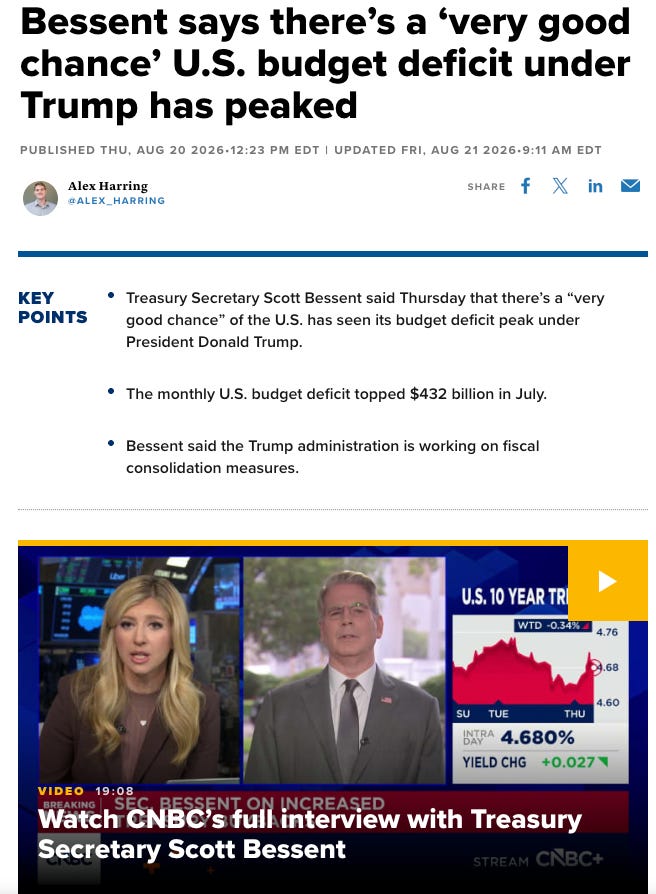
War Inflation notwithstanding, my hope is that the Benign Gravity of Disinflationary Growth turns out to be the stronger secular force in the end that allows the US to grow out of its Deficit the same way we did in the mid-90s. I get that the Treasury Secretary is political, but I think he may end up being right:
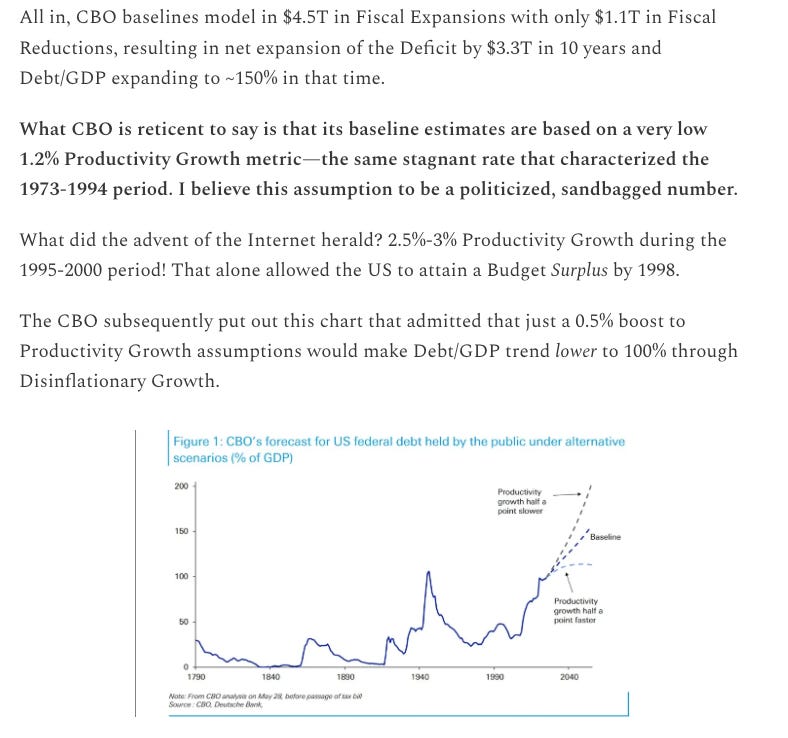
Last summer, I outlined in detail in Asteroid Field how Disinflationary Productivity-led Growth led to a Budget Surplus by 1998:
FOMC Minutes: “Most” Held in July, “Several” Favored a Hike — A hawkish minority wanted to hike to forestall a costlier future sequence, but most expect Inflation to fade as tariff and energy effects wane, with Goldman penciling core PCE at 2.9% by December and the Fed on hold. A boxed Fed in three-part harmony, and Warsh floating fewer meetings a year is a feature to me, not a bug.
USA: Philly Fed Manufacturing Highest Since 2021; Initial Claims Slightly Below Expectations — Philly jumped to its best since 2021 and claims fell, yet both prices-paid and prices-received dropped. That two-sided composition, firm activity with cooling prices, is precisely the Disinflationary Growth I want.
USA: Housing Starts Decline; July Core PCE Tracking 0.20% — Starts softened but Goldman still tracks a benign 0.20% monthly core PCE. This is the setup into the July Inflation read, and you can track multiple measures of Inflation live on UrbanKaoberg.com.
Global Economics Comment: Is AI Impacting Global Labor Markets? — Goldman finds the same muted labor headwinds abroad as at home, with a heavy AI-exposure score shaving only a sliver off headcount growth. Slow, ultimately Deflationary, and consistent with AI as a democratizer of Productivity rather than a Stagflation engine.
Summary
The Deficit clock will keep ticking and the Debt-Doomers will keep pointing at it, but I will keep my eyes on the map, the straits, and the Debt Governor, because that is where the Dollar’s crown is actually won or lost in my view.
KAOS THEORY 14 tapes end of this month with Lakshmi Sreekumar as our guest; with the Macro backdrop this fluid, stay tuned!
If this read on Geopolitics, Oil, and the AI cold war is useful, subscribe and join the paid ranks for the full Archive, Daily Chats and access to the UrbanKaoberg Closed Beta.
That wraps this Weekly KAOS. If you enjoyed this paid post, please spread the word!