


Welcome to KAOS THEORY — a podcast collaboration between Grant Williams and me that focuses on the intersection of Macroeconomics and Geopolitics in an increasingly disorderly world.
12/6/25: Episode 11 — Barry Strauss, Redux
Studying ancient history can really give us long-term perspectives to help us overcome recency bias in modern geopolitics.
Barry Strauss, best-selling author of many books on ancient history as well as Senior Fellow at Hoover and Professor Emeritus at Cornell, returns to KAOS THEORY for a sweeping conversation that bridges ancient history and modern geopolitics.
Drawing on his new book, Jews vs Rome, Barry explores how Israel’s struggle to survive between rival powers mirrors ancient Judea’s perilous position between Rome and Parthia, and why geography, alliances, and internal cohesion have always mattered as much as military strength.
From the deep historical ties between Jews and Iranians to the internal divisions that have repeatedly proven as destructive as any external enemy, the discussion uses the past as a lens through which to understand today’s Middle East, America’s shifting role, and the timeless challenge of leadership in moments of civilizational stress.
Barry is a Corliss Page Dean Senior Fellow at the Hoover Institution as well as the Bryce and Edith M. Bowmar Professor in Humanistic Studies Emeritus at Cornell University. He is a recognized authority on the subject of leadership and the lessons that can be learned from the experiences of the greatest political and military leaders of the ancient world (Caesar, Hannibal, Alexander, among many others). These lessons apply to business and government leaders of today who are faced with complex issues that are both challenging and often defy easy solutions.
In addition to writing ten books, Strauss has spoken at the Hoover Institution, the Center for European Policy Analysis and many universities, institutes and war colleges here and abroad as well as for AXA Investment Managers and Cornell Executive Business Education. His articles have appeared in the Wall Street Journal, the Washington Post and the L.A. Times. Most recently, Strauss has been interviewed on CNN’s Fareed Zakaria GPS, A&E, the History Channel, the BBC and PBS.
Where you can find Barry Strauss:
Website: https://barrystrauss.com/
Facebook: https://www.facebook.com/barrystrauss.author
LinkedIn: https://www.linkedin.com/in/barry-strauss-8848702/
Show Notes
Once again, I am sharing my outline for this conversation. It contains some interesting historical details that we did not get to cover in our conversation.
KAOS THEORY 11: Barry Strauss Redux – Ancient lessons that still shape the modern Middle East.
Interview Agenda:
1. Re-Intro/Motivation
Studying ancient history to overcome RECENCY BIAS:
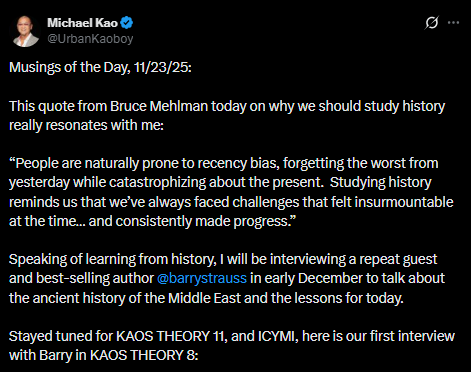
Today’s focus
Examining the geopolitics between Israel and Iran through the lens of ancient history
Examining leadership styles from ancient history vs. now
2. What can we learn about Israel/Iran from Ancient Rome?
Discuss recent article: “Israel vs. Empire”: https://www.thefreedomfrequency.org/p/israel-vs-empire
“Israel is a small land located between great powers. ‘Twas ever thus.”
Judea as a small power caught between imperial systems—Egypt, Persia, Rome.
How did Israel’s geography make it perpetually vulnerable yet also resilient?
“Israel needs to look east as well as west…The hatred that the Islamic Republic of Iran holds for Israel is a historical aberration.”
“History suggests that Israel and Iran are natural friends.”
Iran / Parthia
Ancient Iran during our period of examination:
Achaemenid Persia/Cyrus the Great
Parthian rule
Sasanian rule – Judea renamed Palestine by Romans
Netanyahu reading Jews vs. Rome
“The Talmud concluded that it wasn’t the Romans who destroyed Jerusalem. Rather, it was the “senseless hatred” of Jew vs. Jew.”
Comparison of Israel’s internal disunity with the internecine fighting during the The Great Revolt of 66-70 CE
Barry’s Freedom Frequency piece draws a haunting parallel between Jerusalem’s civil strife in 70 CE and Israel’s internal divisions before the October 7 attacks.
New book: Jews vs. Rome:
Motivation: Why do wars fought two millennia ago—feel so urgently relevant in 2025, and what motivated you to retell these stories now?
Chronology:
63 BCE: Roman Republic under Pompey conquers Judea and makes it a client state. Ironically, the Jews invited the Romans in to settle a dynastic dispute. They didn’t expect Pompey to reduce their territory, to demote their king to tetrarch (subordinate ruler), and to desecrate their holiest shrine.
Lingering resentment: The loss of independence led to a constant undercurrent of discontent and fueled messianic hopes and dissident movements.
Internal division: The Jewish population was often divided between those who sought to cooperate with Roman rule and those who were determined to rebel.
Judea eventually brings in Parthians, Rome re-conquers Judea as Parthian client state
37 BCE: Herod the Great is installed as a client king of Judea during the time of Augustus’ ascension to role of Emperor
3 Major Jewish Revolts
66-70 CE: The Great Revolt
This is the most well-known conflict. It was sparked by religious clashes and political unrest and culminated in the Roman siege and destruction of Jerusalem and the Second Temple in 70 CE. The war ended with the Siege of Masada, where Jewish rebels chose mass suicide over surrender to the Romans and resulted in the destruction of Temple.
116-118 CE: The Diaspora Revolt (aka Kitos War)
Rebellions during Trajan’s Parthian campaigns, and perhaps one of reasons why Trajan fails in Parthia. This uprising was ignited by heavy taxes across the Roman Empire and occurred in Jewish communities outside of Judea.
132-146 CE: The Bar Kokhba Revolt
The final major Jewish rebellion against Roman rule, which was ultimately and brutally crushed. Occurred under Hadrian, and the guerrilla campaigns caused Hadrian to pull legions from Britain
Parallels to today?
Religious conflict: clash of worldviews between monotheistic Jewish beliefs and Roman polytheism/emperor worship? Barry thinks that people overdo this: “The Romans didn’t have a religious problem with the Jews: they had a political problem. Likewise, the Jews (or at least the Jewish rebels) had a political problem with Rome: they wanted to be independent. True, on both sides, but especially for the Jews, politics had a strong religious dimension, which complicated matters. But the Romans didn’t really care what god/s you worshipped as long as you were subordinate to Rome and as long as you included the emperor in your worship (which the Jews, in fact, did: they sacrificed on behalf of the emperor in the Temple).”
Geopolitical struggle: The revolts were influenced by the larger geopolitical struggles between Rome and the Parthian Empire.
Internal strife: internal conflicts, divisions, and complex figures within the Jewish population, such as the Jewish commander turned Roman historian, Josephus, and the Jewish princess Berenice
Similar to some of the sectarian strife amongst its Arab neighbors of today, as explored in KAOS THEORY 10:
In both ancient and modern Israel, internal conflict has preceded catastrophe. Can Israeli democracy sustain its vitality without collapsing into factionalism? Barry: “It’s not just a question for Israeli democracy but for American democracy as well. Here too factionalism, which we tend to call polarization, is rife.”
Do today’s citizens have “skin in the game” like ancient citizens?
Barry: “For all its flaws, Israel is a society whose citizens – at least its Jewish citizens – know what they’re all about. And, when push comes to shove, they put their lives on the line for their country. Can we say the same of Americans? This brings up my two “Hobby Horses”:
Hobby Horse 1: Conscription. “Or, if you prefer, national service – gives people a sense of purpose.”
Hobby Horse 2: Education. “A healthy society teaches its young people history, and it paints a mostly positive picture of its country’s history and current status. It’s dangerous and self-destructive to offer young people a negative view of their country.”

3. What can we learn about leadership styles from ancient history?
Recent article: “To Understand Trump, Look to the Roman Empire”: https://time.com/7327223/understand-trump-roman-empire/
Trump’s leadership approach in ME is “very Roman”:
Emphasis on personal relationships
Unconventional choices in Witkoff and Kushner
Is Trump’s reliance on family emissaries (Kushner, Witkoff) and direct relationships an echo of the Roman system of “friendship” between rulers?
Use of Carrots vs. Sticks
“Romans were masters at using rewards and punishments to manage foreign states…”
Pax Romana vs. Pax Americana comparisons
Romans leaned on its legions in the end
Trump differs from Romans in leaning on “allies to do hardest jobs while keeping Americans out of harm’s way.”
Rome’s peace was built on dominance and deterrence. Is America’s “peace through strength” the same?
“Yes, but I would add that both Rome and America offered/offer positive things as well.”
“Also, although America has done some brutal things (e.g., Hiroshima), it is less brutal than Rome.”
Alignment of Interests
“Nations don’t have friends, they have interests.”
How does Trump try to align the incentives of the ME with those of America?
Can the Gaza Peace Accord endure, and what are the implications for the Abraham Accords?
Broader lessons of Leadership from ancient history?
Book: Masters of Command
Leadership lessons from 3 great generals of ancient history:
Alexander the Great
Hannibal
Julius Caesar
10 qualities of successful commanders
Ambition
Judgment
Leadership
Audacity
Agility
Infrastructure
Strategy
Terror
Branding
Divine Providence.
How would you grade the current Administration on this list?
If you enjoyed this episode, please make sure you check out:
Kaos Theory Episode 8: Barry Strauss
·
Welcome to KAOS THEORY — a podcast collaboration between Grant Williams and me that focuses on the intersection of Macroeconomics and Geopolitics in an increasingly disorderly world.


